Road Safety
NHMP Training College
Road Safety Awareness Unit
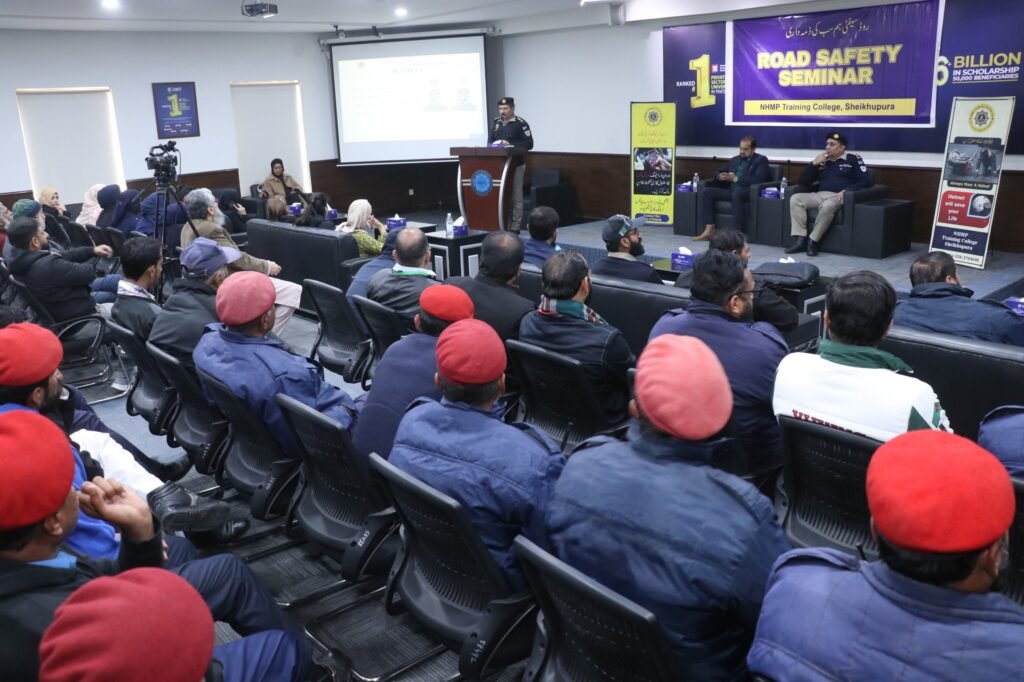
The Road Safety Awareness Unit (RSAU) at NHMP Training College is the College’s central hub for road-safety education, behavioural change interventions, and technical support for highway policing across Pakistan. The Unit combines operational training (for NHMP officers and allied enforcement staff), community outreach (drivers, students, transport companies), and evidence-driven policy support (data analysis, hotspot mapping and technical advice to provincial and federal road-safety bodies).
RSAU’s work covers the full prevention chain: reduce exposure to high-risk situations, change driver behaviours (speeding, distracted driving, non-use of seat belts/helmets), improve post-crash response, and protect vulnerable road users (pedestrians, motorcyclists, cyclists). The Unit also develops locally adapted material classroom modules, short video micro-lessons, roadside demos and checklist tools so that training can scale across NHMP zones and motorway service areas.
In Pakistan
Road Traffic Death Report
Pakistan continues to face a serious road safety crisis with profound human and economic consequences. According to the World Health Organization (WHO), an estimated 27,568 people lost their lives in road traffic crashes in 2021, representing a mortality rate of approximately 11.9 per 100,000 population [WHO-GHE-2021]. WHO further emphasizes that national reporting systems record significantly fewer fatalities than modeled estimates, indicating substantial under-reporting and highlighting the urgent need for stronger crash data systems and more effective enforcement mechanisms [WHO-GSRRS-2023].
Demographic patterns reveal that the burden of road crashes disproportionately affects Pakistan’s youth. Data from Rescue 1122 and the Asian Transport Observatory (ATO) show that approximately 65% of total crash victims fall within the 16–35 years age group, with 16–25 years accounting for nearly 35% and 26–35 years for about 30% of cases [Rescue1122-Annual-Data-2024; ATO-PRSP-2025]. Children under 14 and adults above 65 collectively represent around 30% of total fatalities, underscoring vulnerability at both ends of the age spectrum. Gender distribution is similarly uneven: 80–81% of victims are male, primarily due to higher mobility rates and motorcycle usage, while females constitute approximately 19–20% of reported cases [Rescue1122-Punjab-Annual-Data-2024].
Motorcycles remain the dominant risk factor in Pakistan’s crash profile, being involved in approximately 75% of all reported accidents. Cars account for 8.6%, rickshaws 4.7%, buses, trucks, and vans collectively 4.3%, and other vehicle types 7.4% [Rescue1122-Annual-Data-2024]. Additionally, pedestrians are affected in 10.34% of road crashes, reflecting persistent infrastructure deficiencies, enforcement and awareness gaps for vulnerable road users.
Beyond the tragic loss of life, road traffic crashes impose a significant economic burden. The Asian Transport Observatory (ATO) estimates that road crashes cost Pakistan nearly USD 12 billion annually, equivalent to 3–4% of national GDP [ATO-PRSP-2025]. This aligns with the World Bank’s 2023 assessment that road crashes cost countries between 3–5% of GDP. Notably, this economic loss exceeds Pakistan’s public health expenditure share of approximately 2.9% of GDP, positioning road safety not only as a public health concern but also as a critical development and economic stability issue. The financial impact extends across healthcare costs, property damage, productivity loss, and infrastructure strain, thereby constraining national growth.
In this challenging context, the Road Safety Awareness Unit (RSAU) plays a strategic and preventive role in bridging enforcement and education gaps. Through structured officer training, community outreach initiatives, hotspot-based crash analysis, and partnership-driven awareness campaigns, RSAU supports evidence-based interventions aligned with the UN Decade of Action for Road Safety 2021–2030. By promoting responsible road behavior and fostering a culture of compliance, RSAU contributes not only to saving lives but also to reducing preventable economic losses that hinder sustainable national development
Empowering safer journeys on Pakistan’s Motorways & Highways through targeted training, public awareness, enforcement support and evidence-based policy guidance.
Objectives
Develop sustainable institutional capacity within NHMP by integrating modern road safety education, intelligent enforcement strategies, and professional training
On critical risk factors including speed management, seat-belt and helmet compliance, driver fatigue, distracted driving, and protection of vulnerable road users.
Through systematic data collection, research analysis, monitoring, and impact evaluation.
with transport departments, provincial authorities, academia, and international development partners to maximize national road-safety impact